
Southwest Los Angeles: Why We Bet on This Corridor.
We get asked the same question a lot: why Southwest LA?
The honest answer is that we saw what others were slow to see. A corridor with deep cultural roots, genuine community pride, and decades of deferred investment — sitting at the intersection of transit, entertainment, and a city finally paying attention. We didn't choose Southwest Los Angeles because it was convenient. We chose it because the fundamentals were undeniable, and the timing was right.
Here is what we know, and why we believe the next decade belongs to this part of the city.
The Infrastructure Has Arrived
In Los Angeles, transit infrastructure is the most reliable predictor of neighborhood transformation. Look at Silver Lake, the Arts District, or Highland Park — each one traced its trajectory back to a moment when meaningful public investment arrived and the market followed.
Southwest LA's moment is now.
The Metro K Line — running 11 miles through South Los Angeles, Inglewood, and Westchester, now connecting directly to LAX through the Transit Center that opened in June 2025 — is the spine of this entire corridor. It isn't coming. It's here. And the data on what transit does to property values in Los Angeles is unambiguous: home prices within a half-mile of rail access grew 61% between 2012 and 2016 — 8% higher than areas without that access.
The K Line Northern Extension, approved by the Metro Board in March 2026, will add 10 new stations along 10 miles of underground rail from the Crenshaw corridor north through Mid-City and West Hollywood, at an investment of over $10 billion. The communities anchoring this network — Leimert Park, Baldwin Hills, Hyde Park, the Crenshaw Boulevard corridor — are not peripheral to this story. They are the center of it.
What Inglewood Proved
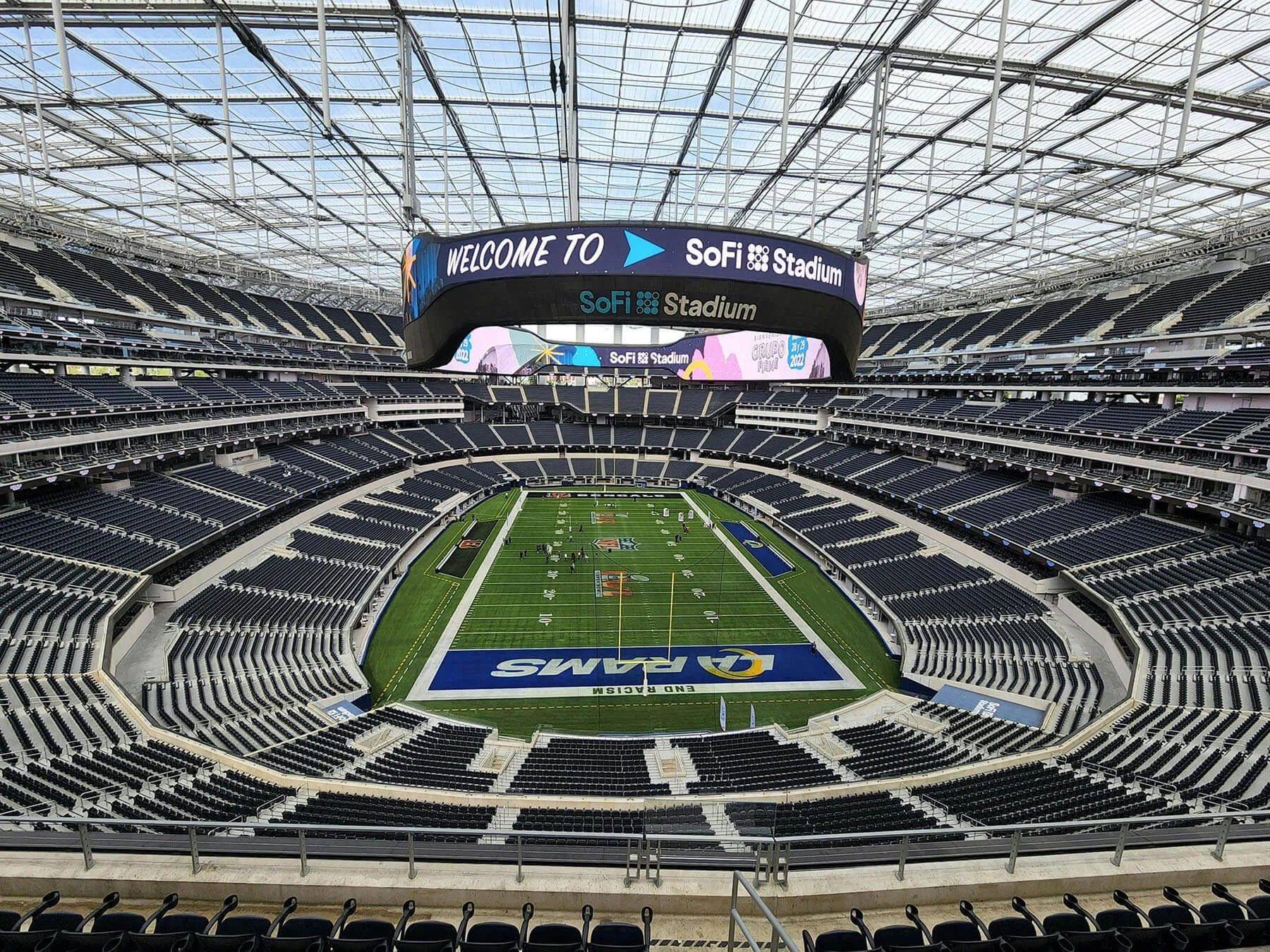
Nowhere illustrates the corridor's trajectory more clearly than Inglewood. When SoFi Stadium was announced, skeptics called it a gamble. What followed was one of the most dramatic transformations in Los Angeles real estate history.
Total property values in Inglewood grew from $9 billion to $17 billion following the Hollywood Park redevelopment announcement. Median home prices rose from $382,000 in 2015 to nearly $720,000 by 2021 — an 88% increase that outpaced the rest of Los Angeles County by nearly 40 percentage points. Commercial real estate within two miles of the stadium saw a 78% price increase between 2016 and 2019 alone.
What Inglewood demonstrated is that when infrastructure, institutional capital, and community identity converge in a supply-constrained market, appreciation doesn't trickle — it surges. And the neighboring communities of Park Mesa Heights, Baldwin Hills, and the Crenshaw corridor are positioned to follow the same arc, with the same transit investment and a fraction of the current price point.
The Olympics Are Coming
The 2028 Summer Olympics will place Los Angeles — and specifically Southwest Los Angeles — at the center of global attention for the first time in four decades.
SoFi Stadium is the designated site of both the Opening and Closing Ceremonies. The K Line now provides direct rail access to the corridor. Developers are already moving: a 300-room luxury hotel is under construction adjacent to the stadium, and the broader Hollywood Park campus continues to expand with retail, hospitality, and media production space across 300 acres.
The Olympic effect on real estate is well-documented. The capital flows in during the years before — not after. The window to acquire ahead of that wave is narrowing with each passing quarter.
The Market Conditions Support It
Beyond the corridor-specific story, the broader Los Angeles market provides a compelling backdrop. Vacancy rates across the city have tightened to approximately 3.1%. The average Los Angeles homeowner has gained over $337,000 in equity over the past seven years — more than double the national average. And Los Angeles County has now posted 15 consecutive years of assessed value gains, a streak that speaks to the structural resilience of this market.
In that environment, a supply-constrained submarket with accelerating infrastructure investment and still-accessible price points represents exactly the kind of asymmetric opportunity that defines long-term wealth creation.
What We're Really Investing In
The statistics matter. But they don't fully explain why we show up to this work every morning.
Southwest Los Angeles has something that no amount of capital can manufacture: identity. Leimert Park is the cultural heartbeat of Black Los Angeles. Crenshaw Boulevard has been a community anchor for generations. The Destination Crenshaw open-air museum — stretching along the very rail corridor we're building around — is a declaration that this community intends to shape its own future on its own terms.
We invest alongside that conviction, not in spite of it. Our work here is not about extracting value from a neighborhood on the rise. It is about developing thoughtfully, building with dignity, and creating assets that strengthen the fabric of a community that has always deserved better than it received.
That is our thesis. That is why Southwest Los Angeles. And that is why now.
